News & Views

11 March 2026
Confronting the legal and social challenges facing survivors of violence and exploitation
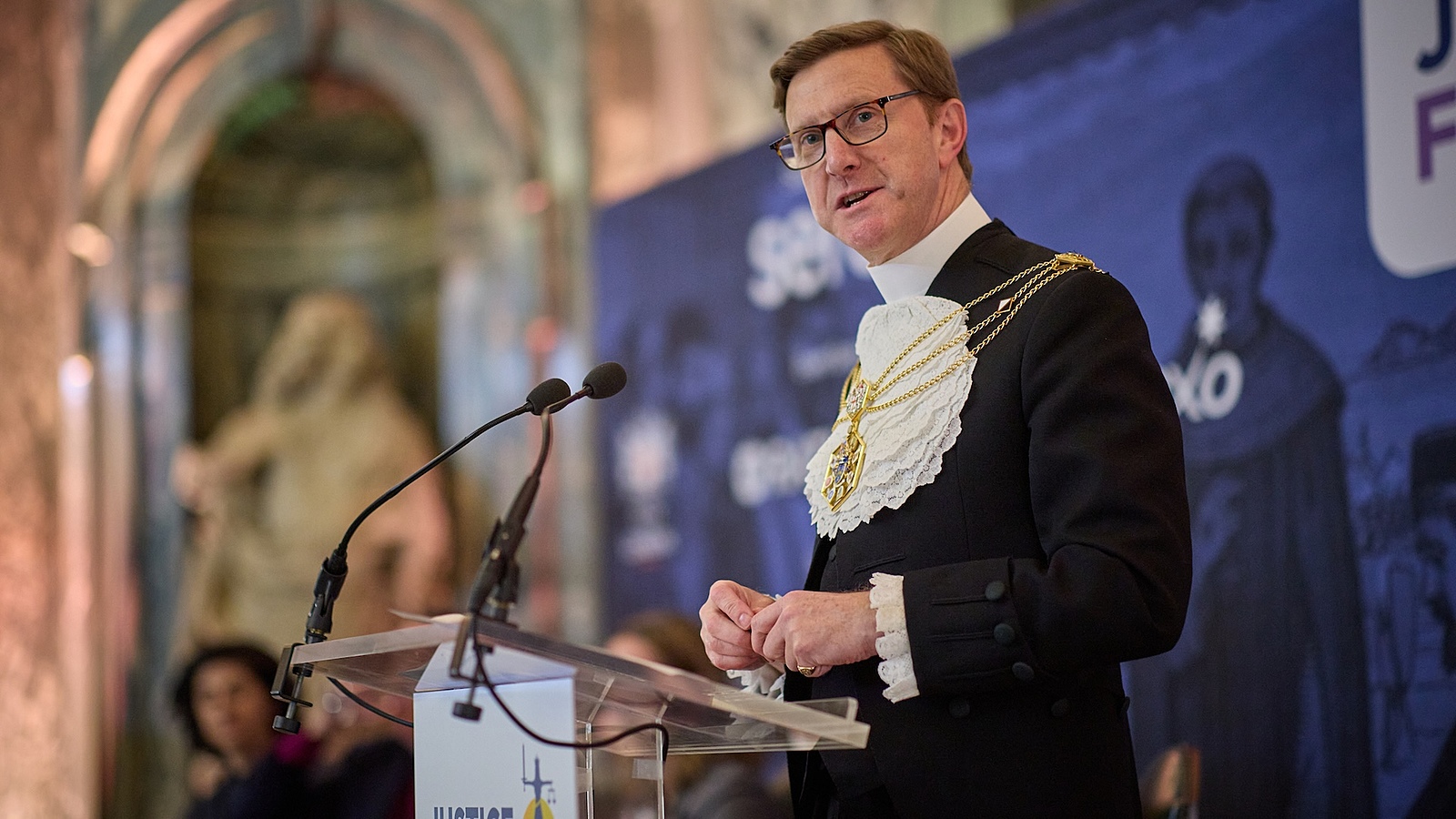
On 23rd March, we will be hosting the next event in our Justice for All Series at The Old Bailey, Justice for Victims and Survivors. Sponsored by Rathbones Group Plc, as well as series sponsor, Serco, the session will confront the legal and social challenges facing survivors of violence and exploitation, including gender-based violence and modern slavery.
On 23rd March, we will be hosting the next event in our Justice for All Series at The Old Bailey, Justice for Victims and Survivors. Sponsored by Rathbones Group Plc, as well as series sponsor, Serco, the session will confront the legal and social challenges facing survivors of violence and exploitation, including gender-based violence and modern slavery.
As with all the events in the series, this one will ultimately into the City's contribution to justice in this context, why justice for all makes economic sense, and how we finance justice going forward.
Within that, the evening will advocate for stronger victim protection, trauma-informed approaches, and effective legal remedies, as well as covering topics including violence, modern slavery, human trafficking, and abuse.
Of all the talks in the series, this is the closest to my professional life, and so here, I wanted to give some thoughts on the work that Rathbones has done to date in this area. It serves as an example both of things that can be done, and the magnitude of what we still need to do - something that can only be achieved if each individual plays their part.
Who are the survivors of violence and exploitation?
While the subject matter might seem fairly obvious to some, the topic of 'survivors of violence and exploitation' covers a broad range of things - once you look beneath the bonnet of the issue, it becomes apparent how systemic it is.
My colleague, Victor Riega, who is Responsible Business Manager at Rathbones Group, puts it eloquently, saying:
"I think first it's important, especially for this event, to establish what we mean by victims and survivors. The key difference between the two is that victims are the people who suffer the consequences of crime, where survivors are usually people who’ve been exploited or enslaved in some way, and have been able to get out of that situation. That can cover a wide range of things, from exploitative labour conditions to domestic violence and rape. This event takes all of that into account."
The legal framework
The issue of modern slavery and human trafficking is a persistent concern. In a report, Rathbones wrote: "Fifty million people are trapped in what’s known as 'modern slavery’. This includes 28 million in forced labour and 22 million in forced marriages, according to the International Labour Organization (ILO), a United Nations agency."
As a brief overview, the legal framework for understanding and combating these issues in supply chains is growing. Notably, that began following the 2004 disaster at Morecambe Bay, where 23 Chinese cockle pickers drowned when they were trapped by rapidly incoming, high-tide waters in the dark. It transpired that the tragedy had involved trafficked workers exploited by criminal gangs, and resulted in a 14-year sentence for the gangmaster and the creation of the Gangmasters and Labour Abuse Authority (GLAA). The incident was a stark example of modern slavery in action.
This incident sparked work at Rathbones, exploring the role that vulnerable migrant labour played in UK supermarket supply chains, with many calling for legislation around supply chains. It was compounded by a series of suicides at Apple supplier Foxconn in 2010 and early 2011, which led to a push for supply chain transparency and scrutiny in the tech industry in California. Rules passed there forced companies like Apple and Siemens to address working conditions, and alongside global legislative action, it also prompted public pressure for greater transparency.
Theresa May was also very proactive on modern slavery, giving the police new powers and incentivising business action to find, fix, and prevent such issues.
Key areas of legislation have included:
- In 2011 the UN Guiding Principles on Business and Human Rights (UNGPs) came out, stating that businesses have a responsibility to respect human rights. That went some way to changing the environment and how human rights were seen from a corporate perspective. It means that businesses need to do what they can to make sure they’re not causing or contributing to human rights issues.
- In 2015 Section 54 (s54) of the Modern Slavery Act made it necessary for companies to publish a statement to ensure modern slavery isn't within their supply chain. However, the onus remains on businesses to be proactive.
- Since 2024, further requirements have been put in place whereby UK companies over a certain size have to show what they are doing to find and combat slavery in supply chains under the 2024 EU Corporate Sustainability Due Diligence Directive.
Going beyond legislation
Legislation can only go so far, however. All it can really do is create a framework for us to operate within, and in many ways, while helpful, it has weaknesses relating to wider due diligence. To really make a difference, we have to be willing, able, and, perhaps passionate as well, about implementing a moral code that we can be proud of. None of us will get that entirely right from day one - it's a complex and evolving issue, but progress is being made, and within that the path to greater success becomes a little clearer.
The cost of exploitation
I think one of the important things is to dispel the myth that these practices are in any way the path to economic success. On the contrary, modern slavery and human trafficking cost the UK economy an estimated £3.3 billion to £4.3 billion annually, according to Home Office research. Other estimates suggest much higher figures, with some indicating a cost of more than £52 billion annually (around 2% of GDP). On a global scale, the International Labour Organization says forced labour generates annual profits of US$150 billion.
While the monetary cost pales into insignificance against the human suffering that these practices create, it is important to quash any discussion relating to the idea that economic efficiencies are an excuse for remaining ignorant.
Matt Crossman, Stewardship Director at Rathbones, whose knowledge on the subject is unparalleled, notes: "Modern slavery is a pervasive systemic risk to portfolio investment. It’s a moral imperative to address it, but there’s also compelling financial and business reasons to combat it as well. As an institutional investor, rooting out these practices is not just a resilience thing; it impacts individual companies and has an overall effect on the environment we try to invest in."
Find, fix, and prevent
Rathbones has been doing a lot of work to address issues of slavery and exploitation in supply chains for many years. For example:
- In 2010, I created and chaired what is now the Rathbones Stewardship Committee, which has engaged in issues including modern-day slavery and seeks to put investor power behind key ESG issues, including transparent supply chains.
- Since 2018 Rathbones has organised an investor coalition to challenge FTSE 350 companies that have failed to abide by s54. The coalition is renewed each year with new companies on its target list. It has now expanded to nearly 200 investors globally, representing trillions in assets under management. The company uses voting rights to demand standardised, transparent reporting from firms, and also advocates for stronger UK human rights.
- Rathbones is part of Find It, Fix It, Prevent It - an investor-led initiative launched in 2019, which is aimed at tackling modern slavery and human rights abuses within corporate supply chains.
The work remains ongoing; Matt says: "What we’re trying to do internally at Rathbones is make sure we have a very good understanding across the whole company of where we are in terms of how we approach the risks of all aspects of human rights. For example, our Human Rights Statement is where everything we're doing comes together as part of a corporate agenda. This is part of that integral push for businesses (ours and the ones we work with) to take more responsibility regarding human rights. Where before it was purely a criminal law issue, it is now a business responsibility as well."
Creating access to remedy
Moving the challenge of addressing human rights violations beyond the realms of criminal law alone, and into a space of collective responsibility, is a powerful step, but it’s naturally and necessarily complex. As a result, some companies have more resources and capacity to dig deeper into their supply chains than others, and of course there’s a need to look beyond simply finding issues and making it easy for organisations and individuals to do something about it without fear of negative reverberations.
Matt says: “Part of the challenge is to create a level playing field - some companies are doing really good things, and it makes sense that all companies look into a similar level of detail when it comes to their supply chains. However, where it gets tricky is not simply in identifying problems, but creating access to remedy with a focus on improvement. As an example, I gave evidence on a Select Committee about forced labour in supply chains, and there was a guy from Philips Electronics there who spoke about one single component in one of their toothbrushes, which was 50 levels deep in the supply chain, where they unearthed an issue. Who is responsible for that? It’s a complex issue, and depending on the industry certain risks are higher and more layered. However, the expectation is still to act on that knowledge somehow, and for all of us to create systems that enable that proactive path to justice.”
Victor adds: "There’s lots of work to be done and it’s quite complex. If you look at investment for example, a bank could be an investor in its own way and can make decisions on how they do that. However, wealth management invests on behalf of clients - they cannot simply decide whether to invest more here or there - it has to be aligned with client preferences and risk profiles. At Rathbones, our investment and fund managers have a lot of autonomy in how they go about decision making. We provide them with a structure they can use to inform the decision-making process, but they don’t have to abide by a specific mandate, with a few exceptions. That means a lot of our work internally is around educating, and providing the right tools. Businesses have to work with their own maturities."
Practical steps towards due diligence
In the past, the answer businesses would have implemented would have been a big whistleblowing contact number, telling staff to call if there's a problem. However, people tend not to know about those, and also it's a very big responsibility for an individual. Instead of doing that, Victor speaks of a more holistic approach - yes, providing a phone number to an established anti-slavery hotline that people can call, but also having more practical conversations.
He says: "Communication is an issue for clients as so many corporates ask them to sign up to specific codes of conduct, and for smaller businesses in particular that can become unmanageable. What I’ve found helpful is to have conversations with suppliers and explain where risks might be. Have you checked your HR database, for example, to make sure you’re not paying several staff members into the same bank account? Is there an HR system in place that will highlight when the same account is used by more than one employee? Often in SMEs the HR function is filled by someone who also has another role, and they don’t necessarily have the time or capacity to look at that level of detail. The challenge for bigger companies might be that they don’t have the resources to have those conversations with all of their suppliers. Finding ways to help implement measures without making it prohibitively complicated is where we can make progress."
Other measures include helping organisations to review their operations and suppliers, and enable them to understand what sort of human rights risks they’re susceptible to. Legislation in the UK is making that fundamentally necessary, so it isn't enough for Boards to say they didn't know about a problem.
Then there's the question of remedy and what that looks like?
Matt says: "It might be compensation, putting things back to where they were, a public statement - it's not just about financial compensation, it's about something that provides a sense of justice for survivors and victims. How do we go about that as investors, making sure we’re facilitating it across the supply chain? A lot of the time the focus is on the biggest brand in the chain and going after them, which from a PR perspective might offer effective publicity, but practically it's less helpful. We don't want businesses to worry about backlash - that’s why the focus is on transparency and creating incentive. We wanted to make sure people go out and look at their supply chains and address problems. After all, the more resilient the supply chain, the better for everyone."
Our shared responsibility
While there might not be a straightforward answer, I have often written about my belief in the importance of community, and The City of London is a unique community with influence both locally and nationally.
In my professional life the knowledge that the actions I take have an impact on individuals and their lives across the country has been a powerful motivator. What we do within our financial institutions has an impact on the world around us.
I have always believed the City is here to serve the nation, and that influence also imbues us all with responsibility. With its specific shape and community of businesses, the City is able to play a part in driving justice for victims and survivors of crime.
I hope you will join us to take the discussion further.
Book your tickets